
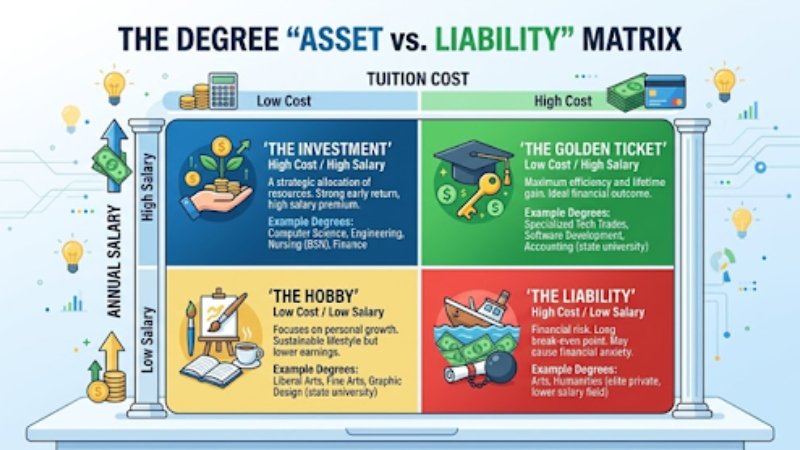
Is Your Degree an Asset or a Liability? Calculating the ROI of Higher Ed
For decades, a university degree was viewed as the ultimate golden ticket—a guaranteed entry point into the middle class and a stable career. However, as we navigate 2026, the math has become significantly more complex. With tuition costs rising faster than average wages, many students are looking at their enrollment papers and asking a high-stakes question: Is this a wealth-building asset, or is it a long-term financial liability?
To answer this, we have to move past the emotional value of “graduation day” and look at the cold, hard numbers of Return on Investment (ROI). In the world of finance, an asset is something that puts money in your pocket, while a liability is something that takes it out. Whether your education falls into the first or second category depends on how you manage your debt, your time, and your career trajectory.
Determining the value of your education requires a deep dive into the Net Present Value (NPV) of your future career. If the total cost of your tuition and the interest on your student loan debt burden exceed the extra money you earn over a lifetime, the degree technically functions as a liability. This is why many students now treat their education like a business venture, often seeking professional Finance Assignment Help from experts at myassignmenthelp to master the complex economic models and debt-to-income ratios required to make sense of their own financial futures. By understanding these metrics early, you can pivot your strategy before the debt becomes unmanageable.
The 1-to-1 Rule: A Simple Litmus Test for Students
In the world of personal finance, a common benchmark for students is the “1-to-1 Rule.” This suggests that you should not borrow more for your entire degree than you expect to earn in your very first year on the job. For example, if you are graduating into a field with an entry-level salary of $60,000, but you have accumulated $120,000 in debt, your degree is currently a liability that will take decades to pivot into an asset.
When your debt-to-income ratio is out of balance, it restricts your “Life ROI.” High monthly payments mean you might have to delay buying a home, starting a business, or investing in the stock market—the very things that actually build wealth. To stay on the right side of this ratio, students are becoming more strategic about their study habits, ensuring they graduate on time and with the highest possible grades to remain competitive.
The Opportunity Cost: What Are You Giving Up?
One of the most overlooked parts of calculating the ROI of higher education is “Opportunity Cost.” This isn’t just about the money you spend on books and housing; it’s about the money you did not earn because you were sitting in a lecture hall instead of working. If you spend four years in school, that is four years of lost wages and four years of missed compound interest in a retirement account.
To make the degree an asset, the “salary premium” (the extra money you earn because you have a degree) must eventually outpace that lost time and money. This is why “Time to Completion” is the most important factor in your ROI. Every extra semester you spend in school is a double hit to your finances: you pay more in tuition and you lose more months of professional income. Managing this workload efficiently is a high-priority skill for modern students.
Strategic Delegation: Balancing Work and Study
In 2026, the most successful students are those who treat their time like a limited currency. They know that failing a class or falling behind on a complex project is a financial disaster. To maintain their “Educational ROI,” many choose to outsource the mechanical, time-consuming parts of their curriculum.
Using a reliable university assignment help service allows students to focus on high-impact learning and networking, rather than getting bogged down in repetitive formatting or basic research tasks. By delegating smaller tasks, you can focus on the core “Finance Subjects” that will actually drive your future income, ensuring you get the best possible return on your tuition investment.
High-ROI Majors vs. Low-ROI Majors
Not all degrees are created equal in the eyes of the bank. While education has intrinsic value, the market assigns different price tags to different skill sets. Currently, fields like Data Science, Nursing, Civil Engineering, and Cyber Security show the highest “Internal Rate of Return.” Students in these fields often see their degree shift from a liability to an asset within just a few years.
| Degree Field | Average Tuition Cost | Entry-Level Salary | Years to Break Even | ROI Rating |
| Computer Science | $40,000 – $80,000 | $85,000 | 3 – 5 Years | Excellent |
| Nursing (BSN) | $30,000 – $60,000 | $78,000 | 4 – 6 Years | High |
| Finance/Accounting | $45,000 – $90,000 | $70,000 | 5 – 7 Years | Strong |
| Liberal Arts | $40,000 – $100,000 | $45,000 | 12 – 15 Years | Moderate |
| Fine Arts | $50,000 – $120,000 | $40,000 | 20+ Years | Low |
The Role of Information Gain in Your Career
Google and modern employers now look for something called “Information Gain.” In SEO, this means providing new value; in your career, it means having a unique skill set that a basic AI cannot replicate. A degree alone is no longer enough to be an asset. You need to combine that degree with “Micro-credentials”—short, specific certifications in things like AI prompting, specialized software, or soft-skill leadership.
By treating your degree as a “Foundational Asset” and then adding these smaller “Value-Add Assets” on top, you insulate yourself against tuition inflation and shifting job markets. You aren’t just a graduate; you are a diversified portfolio.
The Psychology of Debt Stress
We cannot talk about finance without talking about stress. A degree that comes with crushing debt often leads to “Financial Anxiety,” which can actually lower your productivity and health. When a degree feels like a weight around your neck, its “Asset Value” drops because it is hurting your most important tool: your brain.
To protect your mental wealth, you must find ways to reduce the “Cognitive Load” of your studies. This involves everything from proper sleep and “Digital Minimalism” to using academic support systems that prevent you from reaching a breaking point. When you are less stressed, you perform better, graduate faster, and start earning sooner.
2026 Trends: The Rise of the Portfolio Career
The traditional path of “one degree, one job, one pension” is essentially dead. Today’s students are building “Portfolio Careers,” where they might work a corporate job while running a side hustle and investing in digital assets. In this environment, your degree is a credential that opens the door, but your ability to manage finances and time is what keeps you inside.
If you view your education through this lens, you realize that the assignments you do in college are actually practice for the projects you will do in the real world. Learning how to delegate, how to research, and how to use tools is actually a part of your financial training.
How to Pivot a Liability Degree into an Asset
If you are already enrolled in a program with high costs and moderate salary prospects, don’t panic. You can still shift the ROI in your favor by taking specific actions:
- Aggressive Networking: The “Hidden Job Market” is where the high-paying roles live. Your network is often a bigger asset than your GPA.
- Skill Stacking: If you are a History major, learn SQL or Python. Combining a soft-skill degree with a hard-skill certification drastically increases your market value.
- Minimize Time-to-Degree: Use every resource available to ensure you don’t take a 5th or 6th year to graduate. This includes summer classes and professional academic assistance.
- Refinance Early: Keep a close eye on interest rates. Moving from a 7% loan to a 4% loan can save you tens of thousands of dollars over the life of the debt.
Calculating Your Personal ROI: A Step-by-Step Guide
If you want to know exactly where you stand, follow this simple calculation:
- Step 1: Total Investment. Add your tuition, books, interest on loans, and 4 years of “lost” minimum wage (approx. $120,000).
- Step 2: Expected Gain. Find the average annual salary in your field and subtract the average annual salary of someone with only a high school diploma.
- Step 3: The Break-Even Point. Divide your Total Investment by your Expected Gain.
Your break-even point is under 10 years, your degree is a strong Asset. If it is over 20 years, it is currently a Liability, and you need to find ways to lower your costs or increase your future value immediately.
Why Quality Content Matters for Your Academic Success
In the same way that a business needs high-quality SEO content to rank on Google, a student needs high-quality academic output to “rank” in the eyes of professors and recruiters. Submitting mediocre work lowers your GPA, which can limit your access to high-paying internships.
Investing in your writing and research skills—or using a service that ensures your work meets global standards—is a form of “Capital Improvement” for your degree. It ensures that the final product (your diploma) has the highest possible market value.
Conclusion: Taking Control of the Narrative
Is your degree an asset or a liability? The answer isn’t written on your diploma; it’s written in your bank account and your daily schedule. By focusing on high-value skills, minimizing the time spent in school, and using strategic resources like myassignmenthelp to ensure academic success, you can tip the scales in your favor.
Education is the most expensive purchase most people ever make. Treat it with the same scrutiny you would a real estate investment or a stock market trade. When you shift from passive student to active investor, your degree becomes the most valuable asset you will ever own. In 2026, students who succeed understand their education is not just a journey, but a powerful long-term smart financial strategy.
Frequently Asked Questions
How do I determine if my specific degree is a good investment?
The best way to calculate value is to compare your total tuition costs and lost wages against the projected salary increase in your field. If you can “break even” within ten years of graduating, your education is generally considered a high-value financial asset.
Can a degree become a liability even if I graduate?
Yes. If the monthly student loan repayments consume more than 15-20% of your take-home pay, the debt can hinder your ability to reach other financial milestones, such as homeownership or retirement investing, effectively acting as a liability.
What is “Opportunity Cost” in higher education?
Opportunity cost refers to the potential income and work experience you give up while spending four years in a classroom. To ensure a positive return, your future salary premium must eventually outweigh these “lost” years of earnings and compound interest.
How can I improve the ROI of a degree in a low-paying field?
You can shift the balance by “skill-stacking”—combining your primary degree with high-demand technical certifications. Minimizing debt through scholarships, community college credits, or graduating ahead of schedule also significantly improves your long-term return.
About The Author
Min Seow is a dedicated academic researcher and lead content strategist at myassignmenthelp. With an eye for educational trends and digital literacy, Min specializes in crafting insightful guides that help students navigate the complexities of modern higher education. For more details, Click here